
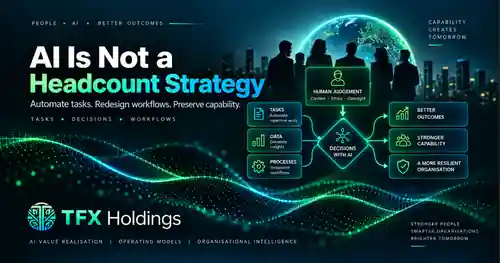
The organisations that treat AI as a headcount exercise may discover too late that they automated tasks while dismantling the capabilities needed to run the business.
One of the more consequential AI predictions this year appeared this week.
Gartner predicts that by 2029, 30% of employees laid off because organisations believed AI could replace them will need to be rehired, often at significantly greater cost.
It is a forecast, not an observed outcome, and should be treated accordingly.
But the mechanism behind it deserves board-level attention now.
The problem is that much of the AI workforce debate starts with the wrong unit of analysis.
We talk about jobs.
AI operates on tasks, decisions and workflows.
That difference can become very expensive.
A job is not a task
Take a seemingly straightforward operational role.
Perhaps 30% of its time is spent collecting information, 20% producing documentation, 15% coordinating with colleagues, 15% making routine decisions and the remaining 20% handling exceptions, customers and judgement-intensive situations.
AI might automate or accelerate a substantial portion of the first three categories.
It does not follow that 65% of the job has disappeared.
The remaining work may now become more important.
Someone must verify the AI’s output.
Someone must understand when the model is wrong.
Someone must resolve exceptions.
Someone must exercise judgement when the situation falls outside the expected pattern.
Someone remains accountable for the outcome.
And as throughput increases, the volume of those remaining activities may increase too.
This is why calculating workforce impact by adding together “automatable tasks” is dangerous.
The economics of a workflow are not the sum of its task percentages.
New research shows what is actually changing
Research released this week by Trinity College Dublin provides useful empirical evidence.
Its Right-Sizing AI at Work study finds that AI’s current impact is occurring primarily through changes to tasks and workflows rather than wholesale elimination of jobs.
Almost half of surveyed workers—47.4%—already use AI daily. Nearly 65% describe themselves as confident using it, and 69% believe they are prepared to adapt their skills.
But the interesting finding is what people increasingly do around the technology.
Workers review.
They verify.
They coordinate.
They apply judgement.
These are not peripheral activities.
As machines execute more work, people increasingly become the control layer around machine execution.
That changes the workforce requirement rather than simply removing it.
The economic leakage happens after the productivity gain
Suppose AI releases the equivalent of 100 full-time employees’ capacity from a business process.
That is not yet a saving.
It is capacity.
Management now has choices.
It can remove cost.
Increase throughput.
Absorb growth without additional recruitment.
Improve customer service.
Reduce backlogs.
Accelerate decisions.
Move people into higher-value work.
Or do nothing deliberately and watch the released capacity disappear into meetings, email and additional activity.
The AI does not make that allocation decision.
Management does.
This distinction is visible at enterprise scale.
Wipro said this week that its AI initiatives have freed capacity equivalent to approximately 20,000 employees across a workforce of around 243,000.
Those people were not simply removed.
The company says the capacity has been redeployed into other roles as it develops what it describes as a human-AI operating model. It has also trained more than 100,000 employees in advanced AI skills.
The number is company-reported, not independently audited evidence.
The management principle is nevertheless important.
Productivity and headcount are different variables.
Redesign the workflow before redesigning the workforce
This is why workforce planning should follow workflow redesign, not precede it.
Start with the business outcome.
Map the end-to-end workflow that creates it.
Then decompose the work.
Which tasks are repetitive?
Which require retrieval?
Which involve synthesis?
Which decisions are rules-based?
Which require contextual judgement?
Where are the exceptions?
Where does accountability sit?
Where does expertise accumulate?
Where does a junior employee learn enough to become tomorrow’s expert?
Only then should leaders decide which activities should be:
automated, augmented, delegated or retained.
That produces a very different workforce discussion from:
“How many roles can AI eliminate?”
It also reveals something easily missed.
Some apparently inefficient human activity is actually part of the organisation’s capability-development system.
Junior employees prepare analysis that senior colleagues review.
Analysts investigate anomalies before learning to make judgement calls.
Support teams handle routine cases before developing the experience required for complex ones.
Automate every entry-level task and the organisation may improve today’s efficiency while quietly dismantling tomorrow’s expertise.
That is precisely the type of institutional capability Gartner’s rehiring forecast warns about.
Adoption needs to become role-specific
The same logic changes AI training.
Generic AI literacy has value during early adoption.
It is not a workforce transformation strategy.
If the workflow changes, training needs to change with it.
A finance analyst may need to learn when to challenge an AI-generated variance explanation.
A customer-service employee may need to recognise when an agent should relinquish control.
A manager may need to supervise a combination of people and digital workers.
An auditor may need to interrogate the evidence generated by an autonomous workflow.
Trinity’s research identifies precisely this gap: workers report relatively high confidence but formal training participation remains weaker, leading the researchers to call for more structured, practical and role-specific skills development.
That is a substantially more mature adoption model.
Don’t train people to “use AI.”
Train them to perform a redesigned role inside a redesigned workflow.
Even the delivery model is changing
Another market signal appeared this week.
Accenture and Google Cloud announced a new enterprise AI group that will include 1,000 forward-deployed engineers working close to customer environments to move AI from experimentation into production.
There is a broader lesson here.
AI transformation increasingly requires expertise at the point where technology encounters real work.
But engineering alone is not enough.
Enterprises also need forward-deployed transformation capability: people who understand workflows, operating models, adoption, governance, economics and organisational behaviour well enough to redesign the system around the technology.
The technology can increasingly be built quickly.
Changing how an organisation works remains the harder problem.
The workforce question needs reframing
None of this means AI will not reduce employment in particular activities or organisations.
It will.
But starting with a workforce-reduction target risks reversing the transformation logic.
The sequence should be:
business outcome → workflow → task and decision redesign → human/AI allocation → capability requirement → workforce implication.
Not:
AI → headcount target → find tasks to automate.
The distinction matters financially.
Cut too early and organisations may later buy back scarce expertise at a premium.
Fail to redesign work and productivity improvements may never reach the P&L.
Train people generically and adoption may rise without changing outcomes.
Automate developmental work indiscriminately and today’s efficiency may create tomorrow’s capability deficit.
AI is not simply changing how much human work organisations need.
It is changing which human work creates value.
That is an operating-model decision.
The executive question
Before your organisation turns AI productivity into a headcount target, can you show which work disappears, which work becomes more valuable, where human judgement remains essential—and how today’s employees become the people capable of exercising it tomorrow?

Leave a Reply